Tony's regret
Thirteen Reasons WhyTony’s regret is the painful recognition that Hannah came to his house carrying several signs of distress, and that he understood their significance only after the fact. Her offer of a bicycle, her tears, and her questions about making recordings acquire a different meaning in retrospect: what had seemed like an unexpected visit between friendly classmates was also a chance for Tony to notice that she needed help. His account does not claim that he knew what was happening at the time; it measures the distance between the signs he remembers and the action he wishes he had taken.
The Visit and the Bicycle
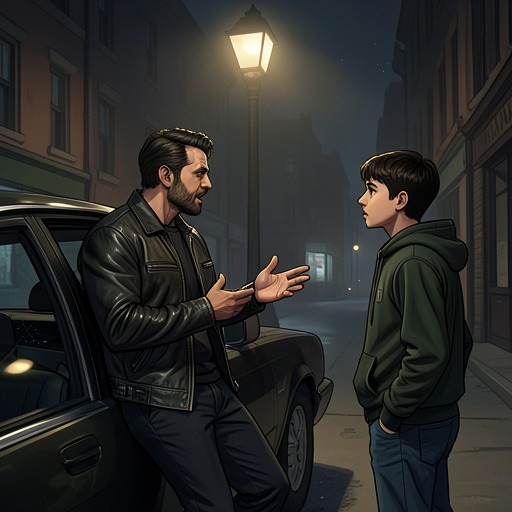
Tony tells Clay that Hannah came to his house and that he saw her visit as a chance. They were friendly at school, but she had never come over before, so he was surprised. The purpose of the visit was concrete: she wanted him to have her bicycle. She said she was done with it, and when he asked why, she shrugged and offered no clear reason. Tony later identifies the gesture as a sign he missed.
Hannah explained that Tony was the only person she could think of who might need the bike. His car, she noted, was the oldest at school, and she thought he might want a backup if it broke down. Tony answered that the car often did break down, but that he was usually around to fix it. He declined to take the bicycle without giving her something in return. His refusal was not presented as hostility; it was a practical response to what he understood as an offer. In retrospect, however, the possibility of accepting the gift becomes part of a larger missed opportunity to ask why Hannah was giving something away.
Tears and the Request to Record
When Tony asked what Hannah wanted in return, he recalled that she kept her eyes fixed on him and began to cry. The memory remains vivid in his account: he describes her looking straight at him while tears streamed down her face. Tony, recounting the moment to Clay, wipes tears from his own eyes and across his upper lip. His physical response makes the regret present-tense, even as the event he describes belongs to the past.
Tony says plainly that he should have done something. He then names the signs that, in hindsight, were there for anyone willing to notice. Hannah asked how he made the tapes he played in his car, and whether he had anything with which to record voices. Tony told her about his father’s old tape recorder. The request is consequential because Hannah was seeking information about recording, while Tony’s account shows that he responded to the practical question without recognizing the larger significance he later assigns to her visit. The available evidence does not say that he understood her intentions then; the regret comes from recognizing the moment afterward.
Recognition After the Fact
The bicycle and the recording questions form a sequence of clues in Tony’s retrospective account. Each could appear ordinary when isolated: Hannah offered a useful object, explained why Tony might need it, and asked about equipment. Together, and especially alongside her tears, they become evidence he wishes he had read differently. Tony’s statement that the signs were all around does not mean that their meaning was self-evident in the moment. It marks the painful change in knowledge between the visit and his later recollection.
That distinction keeps his regret from becoming a claim that he alone could have known or prevented what followed. Tony describes a missed chance to respond, not certainty about what a different response would have changed. His remorse is specific: Hannah was in front of him, crying and asking about recording, and he did not act on what he now recognizes as warning signs. The narrative gives that recognition weight without supplying an imagined alternative outcome.
A Wider Pattern of Unnoticed Warnings
Tony’s recollection resonates with other episodes in which distress is voiced or embodied but not fully met. In class, Hannah uses the paper bag Mrs. Bradley provided for anonymous notes to suggest suicide as a discussion topic, after repeatedly writing and discarding a note about having thought of suicide. Mrs. Bradley later gives local statistics, but the class does not begin the thorough discussion Hannah sought. This episode establishes that signals can be deliberate and still fail to bring the response their author needs.
Later, Hannah describes telling Mr. Porter that she wanted life to stop. He asks whether she knows what she has just said and repeats the concern in a direct question about her life. At a subsequent point in the conversation, he offers two options: confronting the boy involved, or moving on. The contrast with Tony’s retrospective account is not that the situations are identical, but that recognition and response remain separate problems. A warning may be noticed, yet the help offered can still feel limited or insufficient to the person asking for it.
The account of Tony’s regret also sits beside Hannah’s explicit description of a sexual encounter in which she does not say no or push the other person’s hand away, turns her head, clenches her teeth, and fights back tears; she says he sees this and tells her to relax. Elsewhere, she asks Mr. Porter whether what happened might be considered illegal and answers that she does not think so, while also admitting uncertainty. These passages foreground the difficulty of interpreting distress and consent from silence or incomplete speech, and the burden placed on someone in crisis to make the situation legible. Tony’s remorse belongs to this broader narrative of signals, recognition, and failures to help, rather than functioning as proof that any single person or missed moment explains Hannah’s fate.
The Shape and Limits of Remorse
Tony’s memory is framed by an exchange with Clay: he describes Hannah’s visit, Clay recognizes the bicycle as an example of giving away possessions, and Tony returns to the tears and the request about recordings. This structure lets the meaning of the visit emerge through recollection and recognition rather than through an omniscient account of what Hannah intended. The reader encounters Tony’s remorse as an interpretation of remembered details, not as access to Hannah’s unspoken thoughts.
The regret finally rests on a modest but consequential sentence: Tony believes he should have done something. Its force comes from the particulars around it—the bicycle he refused without a return gift, Hannah’s unwavering gaze, her tears, and the questions about a tape recorder. Yet the story does not claim that accepting the bicycle, asking another question, or responding differently would certainly have changed the outcome. Tony’s grief names a missed opening for attention; it does not turn hindsight into certainty.